Ding Yi
Introduction
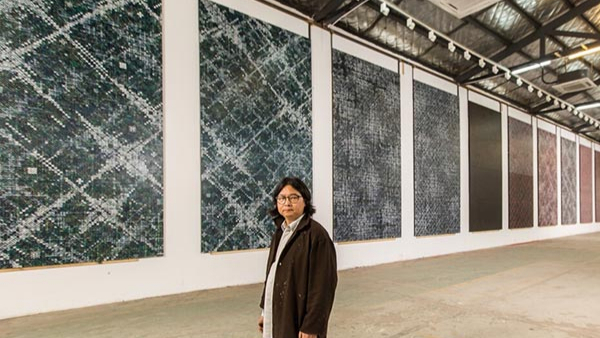
Ding Yi, born in 1962 in Shanghai, China, is a prominent figure in the world of Chinese geometric abstraction. Known for his distinctive approach to abstraction, Ding Yi utilizes the rudimentary motifs of the cross, depicted as both "x" and "+", to construct nonrepresentational works of art. His work is a response to the pervasive Socialist Realist imagery of his formative years and is influenced by his later studies in Chinese ink painting. Ding Yi's artistic philosophy revolves around a detachment from representation, meaning, and emotion, aiming instead to convey spirit and structure through his art. His work spans multiple mediums, including painting, sculpture, spatial installation, and architecture, making him a multifaceted figure in contemporary art.
Early Life and Education
Ding Yi was born and raised in Shanghai, China. His early education coincided with China's cultural revolution (1966-76), a period that profoundly impacted the country's cultural and artistic landscape. Despite the challenges of this era, Ding Yi was able to pursue his passion for art, which eventually led him to Shanghai University, where he studied from 1986 to 1990. It was during this period that he honed his skills and began developing his unique style characterized by nonrepresentational works utilizing the motif of the cross.
His education at Shanghai University included studies in Chinese ink painting, which influenced his later works. The juxtaposition of traditional Chinese artistic techniques with his abstract style allowed Ding Yi to create a unique visual language. The foundation of his artistic practice was laid during these formative years, setting the stage for his future career as a leading figure in Chinese abstract art.
Career
Beginnings
Ding Yi's career began in the late 1980s when he started experimenting with his now-signature motif of the cross. This period marked his departure from traditional representation in art, as he sought to detach his works from meaning and emotion. By establishing a strict set of rules for his artwork, Ding Yi was able to focus on the pure form and structure of his pieces. This approach was a direct response to the Socialist Realist propagandist imagery that dominated China's visual landscape during his early years.
His early career was also characterized by a commitment to exploring the visual and material characteristics of his art, rather than focusing on external context or content. This emphasis on formalism, which lasted for the first decade of his career, was crucial in establishing Ding Yi's reputation as an artist committed to innovation and abstraction.
Rise to Prominence
Ding Yi's rise to prominence was marked by his participation in numerous prestigious exhibitions both in China and internationally. In 1993, he was invited to present his work at the 45th Venice Biennale in Italy. This opportunity, although initially met with mixed reactions, marked a significant turning point in his career. It offered him exposure to international audiences and positioned him as a key representative of Chinese contemporary art on the global stage.
Over the years, Ding Yi's works have been featured in numerous group shows and biennales around the world, including the 11th Biennale of Sydney, the Yokohama 2001 International Triennale of Contemporary Art, and the 6th Busan Biennale. These exhibitions highlighted his innovative use of geometric abstraction and solidified his status as a leading figure in the abstract art movement.
Key Works
Ding Yi is best known for his ongoing series Appearance of Crosses, which he began in the late 1980s. This series is characterized by the use of the cross as a fundamental visual element, around which each composition is built. The works in this series are created through a meticulous process that involves mapping out compositions on wood and paper supports before using unmixed paints to realize the final piece. This method ensures that the resulting artworks are detached from representation and imbued with a sense of spiritual expression.
In addition to the Appearance of Crosses series, Ding Yi has explored various themes and techniques throughout his career. His Fluorescent series, for example, uses vivid colors and fluorescent pigments to capture the vibrancy of urban life and the rapid pace of urbanization. This series reflects Ding Yi's ongoing engagement with the changing cultural and social landscapes of China and the world.
Artistic Style and Influence
Ding Yi's artistic style is characterized by its geometric abstraction and the innovative use of the cross motif. His work spans several artistic styles, including maximalism, minimalism, experimental, post-modern, and formalism. Despite these diverse influences, Ding Yi's style remains uniquely his own, distinguished by its focus on structure, rationality, and the essence of things.
His approach to art is deeply influenced by his early exposure to Socialist Realism and his later studies in Chinese ink painting. These influences are evident in his emphasis on form and structure, as well as his commitment to creating art that is detached from representation and emotion. Instead, Ding Yi seeks to convey a sense of spirit and structure through his work, challenging viewers to engage with his art on a deeper, more abstract level.
Recognition and Awards
Throughout his illustrious career, Ding Yi has received widespread recognition for his contributions to the field of contemporary art. His works have been included in numerous prestigious exhibitions and have been showcased at renowned institutions such as The British Museum, San Francisco MoMA, and the Solomon R. Guggenheim Museum. These exhibitions have not only increased his visibility but have also solidified his reputation as a leading figure in the abstract art movement.
Ding Yi's innovative approach to geometric abstraction has earned him acclaim both in China and internationally. His ability to transcend cultural and artistic boundaries has made him a true pioneer in the field, and his works continue to inspire and influence artists around the world.








